1938: Panaghia, this Glasgow built (1928) steel steam-powered freighter wrecked in Seal Bay, in Cape St Francis in the Eastern Cape due to dense fog. Its boilers can reportedly still be seen at low tide. This happened whilst she was sailing from Argentina to Australia in ballast. Captain Pettersen salvaged the wreck. Panaghia was built by Hamilton Wm. & Co. Ltd., Glasgow for Temple SS Co. Ltd., London SS Temple Lane who owned the vessel from 1928 to 1937 before Kassos Steam Navigation Co., Syra (Syros) SS Panaghia took over the vessel in 1937.
1980: Rijnmond IV, this South African fishing vessel of 241 tons with a crew of 21 capsized and foundered about 30km west of Cape Point in the Western Cape. At the time she was owned by Rederij & Haringhandel N.V. Parlevliet,N. Jr., Katwijk Aan Zee.
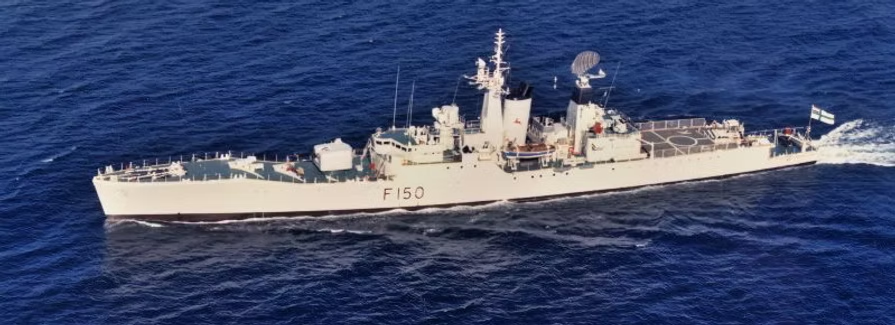
1982: President Kruger –
On the morning of 18 February 1982, President Kruger was conducting anti-submarine exercises for the Submarine Officer Commanding Course with President Pretorius, Emily Hobhouse and Tafelberg. The high-intensity exercises progressed from 06:00 to 23:00 over several days, with different candidate submarine captains being given an opportunity of executing a mock attack against Tafelberg. The rest of the day, the ships followed a narrow zig-zag course that allowed the submarine repeated opportunities to engage the surface ships in lower-intensity exercises while the bulk of the crew rested. The frigates too were using the opportunity to carry out anti-submarine exercises, with each ship given a patrol sector ahead of Tafelberg. The escorts were expected to patrol their areas in a random fashion 2,000–5,000 yards (1,800–4,600 m) from Tafelberg. President Kruger’s station was on Tafelberg’s port side between 10 and 330 degrees and President Pretorius had a station on the starboard side.
At approximately 04:00, the whole formation had to change direction by 154 degrees, a near complete reversal in direction, to stay within their training area. The frigates had to change direction first to maintain their protective positions ahead of Tafelberg on the new heading. President Kruger’s options were to turn 200 degrees to port, or 154 degrees to starboard. While the latter turn was smaller and tactically sound, it was more dangerous as it involved turning towards the other two ships. Critically, the inexperienced officer of the watch (OOW) elected to turn to starboard, and initiated a turn with 10 degrees of rudder rather than the standard 15-degree turn. A 10-degree turn had a larger radius and would take longer to execute than a 15-degree turn, thereby allowing Tafelberg more time to close on the ship turning in front of her. Shortly after beginning the turn, an argument ensued between the OOW and the principal warfare officer (PWO) over the proper amount of wheel to apply. About two-thirds of the way through the turn, the operations room lost radar contact with Tafelberg in the clutter because the high-definition navigation radar was broken and the ship was using the less-precise search radar. The OOW was unable to recover the situation, and Tafelberg’s bow impacted President Kruger on her port side at 03:55. The impact tore a large hole in her side and killed 13 of the 15 men sleeping near the point of collision. The ship took on a large list and the captain ordered “abandon ship” at 04:32. The exercise was immediately terminated and the other ships present began rescue operations. More ships, both military and civilian, began arriving after dawn, as did aircraft from the South African Air Force. A total of 177 crewmen of the 193 aboard were rescued.
A naval board of inquiry was appointed shortly afterwards that determined the cause of the collision was of a lack of seamanship by the captain and watch officers of the ship. The Justice Minister, Kobie Coetsee, subsequently introduced a retrospective change in law to allow him to hold an inquest into the death of the only crewman whose body was found. The inquest lasted a year and apportioned blame on the captain and PWO.
Read the report by Rear Admiral Chris Bennett SD SM SAN (Rtd) (8 December 1937 – 17 August 2021) was the author of a number of books. Bennett was born in KweKwe. He attended school at Kingswood College before joining the South African Navy. He commanded the Minesweeper SAS Mosselbaai in 1972. He was promoted to rear admiral in 1986 and appointed as Flag Officer Commanding Naval Command West until January 1989. In 1989 he was appointed Chief of Naval Staff and then as Chief of Naval Support. He retired in 1990.
DOWNLOAD ‘The loss of SAS President Kruger’ by Rear Admiral Chris Bennett.
Local CHAPTER’s Annual Commemoration:
Charles Ross writes: As there was no event in Pretoria this year, as in previous years, to commemorate the sinking of the SAS President Kruger on 18 February 1982, the Pretoria Navy Olds and Bolds rescheduled its mid-month gathering from Thursday, 20 February, to Tuesday, 18 February, to mark the occasion.
A well-attended gathering, which included three survivors—Dennis Forrest, Mark Venter, and Graham Davies—took place at the Sportsman’s Bar at the Harlequins Club. During the event, the group observed a moment’s silence to remember those no longer with us. Members have expressed their willingness to assist in organising an event in 2026. As always, a broad range of topics was discussed.

Good wishes and apologies were received from Dunstan Smart, Evert Groenewald, John Orrock, Trevor Beddy, Errol Massey-Hicks, Steve Du Toit, Alan Claydon-Fink, Nick Snyman, Peter Eldon, Sonica Van Rooyen, Stan Slogrove, Clyde Stirling, Rob Tomson, Dean Gillespie, Randy Stone, Andre Geldenhuys, Basie Broekman, Michal Grobbelaar, Corrie Van Rooyen, Steve Artman, Andrew Wood Wright, and Philip Gohl.
Gqeberha connection: Local man Allan Macphail was an acting Leading Seaman in the engine room of the President Kruger when the SAS Tafelberg slammed into the Kruger. Allan survived.
1992: Jenny-Lee, this South African tuna-fishing vessel foundered about 100km west of Lamberts Bay off the west coast in the Western Cape after being struck by giant waves. All on board were rescued. MFV JENNY LEE (SBA602) was a 70 ton South African Lampara Purse Seine Fishing vessel that foundered 51nm West of Lambert’s Bay in 1992 after being hit by a big wave. Built by Fred Nicolls, Durban, SA and owned by J. A. Walsh.


