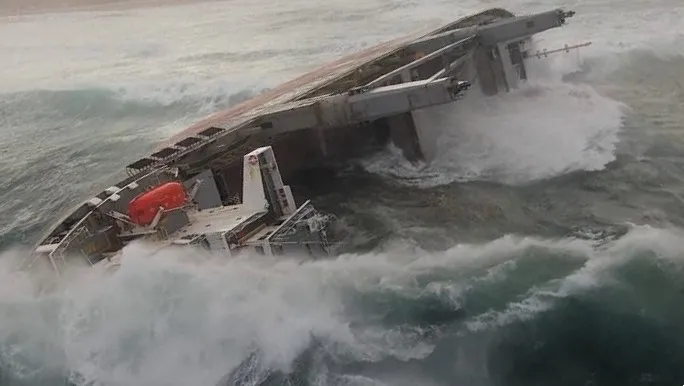
2024: The MV Ultra Galaxy vessel ran aground on the evening 9 July off the coast of Duiwegat, south of Brand se Baai on the West Coast.
The ship was abandoned by her crew of 18 Filipino seafarers after developing an excessive list. The crew returned safely back to the Philippines.
The ship’s hatch covers were dislodged in extreme weather and detached from the vessel, leaving the cargo holds vulnerable and a significant part of the ship’s fertiliser cargo was swept away by the sea.
The Panama-registered MV Ultra Galaxy (previously known as Thor Galaxy and Thorco Galaxy) was a 124.56-meter-long general cargo vessel built in 2008. At the time of its distress call early on Monday, she was on her way to Dar es Salaam in Tanzania.
On 08 July, the South African Maritime Safety Authority (SAMSA) reported rescuing crewmembers from a lifeboat after they evacuated their heavily listed cargo vessel in the Atlantic Ocean. The incident occurred around 60 nautical miles west of Doring Bay, on the west coast of South Africa.
In the early hours of Monday, at 3:00 AM local time, the Emergency Position Indicating Radio Beacon (EPIRB) detected an alert from the vessel ULTRA GALAXY. Promptly, SAMSA responded to the distressed vessel and launched a rescue operation.
SAMSA coordinated with the Maritime Rescue Cooperation Centre (MRCC) in Cape Town, diverted two nearby cargo vessels and coordinated other ships in the vicinity to assist in the rescue operation.
18 Crew Members of ULTRA GALAXY Were Saved by Diverted Vessels
The containership RIO GRANDE EXPRESS, bulk carrier FIVOS, and fishing boat MALACHITE diverted their route and came for assistance. After arriving in the region, the rescue vessels found 18 crewmembers of ULTRA GALAXY in the life raft on the water.
SARMA reported that all the crewmembers were safe and boarded the fishing vessel MALACHITE. The rescued crewmembers are from the Philippines and were en route to St. Helena Bay, west coast of South Africa.
After the rescue operation, SAMSA deployed two tugboats to tow the distressed vessel.
Report from 23 August 2024:
With removal of all remaining oil and fuel onboard the grounded and now wrecked Panama-flagged general cargo vessel, the MV Ultra Galaxy, no longer feasible; the salvage effort has smoothly moved onto removal of the wreck off the South Africa’s west coast beach, as soon as possible, according to the South African Maritime Safety Authority (SAMSA) in a statement on Friday.
SAMSA, in statement in Pretoria, confirmed that a tender invitation to industry had recently been issued, with keen services suppliers’ interest having already been noted from both locally and aboard.
This, according to SAMSA, is consistent with and a follow-through to the authority’s directive to the vessel owners to have the wreck removed from the South African west coast on the Atlantic Ocean.
“As a result,” said SAMSA: “the P&I Club issued an invitation to tender to industry in the last week, with interest from both local and international companies.”
On the current condition of the beached vessel now overturned, broken into two distinct pieces, with breached oil and fuel tanks, as well as requisite activity related thereto, SAMSA said: “Following extensive assessments conducted over the past few days, it has been confirmed that the MV Ultra Galaxy has completely broken up due to the severe weather conditions experienced last weekend.”
Over 500 tons of oil and fuel, as well fertiliser cargo lost at sea due to stormy weather
This was in confirmation that due to incessant wintry and windy weather conditions over several weeks since the grounding of the vessel in early July 2024, all oil and fuel that had remained onboard the vessel had unavoidably been lost as spilled out to sea, and spread out to a nearby beach where it is currently being collected.
According to SAMSA, at the time of the vessel’s grounding in early July, she had a full load of fertilizer in bags onboard. “Due to the extreme weather conditions at the time and the angle she was at, the ship’s hatch covers were dislodged and detached from the vessel.
“Without hatch covers the cargo holds were left vulnerable and consequently, the ship’s entire load of fertilizer cargo was swept away by the sea. As the fertilizer dissolves water, water samples testing was done, and to date, zero reports of a negative impact to the environment has been received.
SAMSA further explained that in terms of the types of fuel the casualty vessel had onboard at the time of the grounding incident, additional to low amounts of hydraulic and related oils she had 332 tons of VLSFO (low sulphur) and 180 tons of MGO in her tanks as bunker fuel.
“Before she started breaking up salvors were able to remove eight (8) tonnes of bunkering marine gas oil from the wreck while the rest of the oil unfortunately spilled after they were compromised due to extremely bad weather and landed up on the beaches directly in front of the vessel,” said SAMSA.
On Friday SAMSA said: “Given the extent of the damage, the likelihood of any intact fuel tanks remaining on the vessel is highly unlikely. Consequently, the initial plan to pump the remaining oil from the wreck with the assistance of the Platform Supply Vessel (PSV) is no longer feasible.
“With all the fuel presumed to have been released and collected on the nearby mining beach, the focus of the operation has now shifted to a monitoring and caretaking phase.
“Inspections conducted by foot, drone, and helicopter yesterday (Wednesday) indicate that the oil on the mining beaches has been cleaned and that there is no visible oil slick or contamination along the beaches, extending as far down as the Olifants River mouth and five (5) km north of the wreck.
“Cleanup crews remain on high alert and are on-site in full force, with any resurgence of oil only being sighted on the beaches immediately in front of the vessel. Despite the successful cleanup of all oil that was deposited onto the beach on Monday, the cleanup teams will remain on-site for at least the next two (2) storm cycles as a precautionary measure,’ said SAMSA.
Salvage team to scale down, with watchful eye on prevailing conditions
With the casualty vessel’s conditions having now changed significantly, SAMSA said the salvage team would be downscaling their efforts on-site while maintaining daily reports on the condition of the wreck.
“These reports will include drone footage, monitoring of the wreck’s movement, and early warnings for any small pockets of oil that may still be trapped in the hull. This approach ensures that we remain vigilant in mitigating any further environmental impact.
“SAMSA remains committed to working closely with all relevant authorities and stakeholders to manage the ongoing situation effectively. We will continue to provide regular updates to keep the public informed of the progress and any new developments.
“We would like to thank all the teams, including the community involved for their tireless efforts and continued support and vigilance during this challenging time.
7 February 2025 Report:
Beaches along the West Coast were soiled with oil spilling from the wreck of the MV Ultra Galaxy which ran aground in July 2024.
- Clean-up operations continue on West Coast beaches after an oil spill from the wreck of MV Ultra Galaxy.
- A local conservationist says she is impressed by the quick response from authorities.
- Over 4,000 tons of material has been collected from the wreck site so far.
Clean-up operations are continuing on West Coast beaches after the recent oil spill that has now been confirmed as originating from the wreck of MV Ultra Galaxy.
A workforce of some 180 people in 12 teams are cleaning beaches along a 40km section of coastline and are making “steady progress”, according to a statement by the South African Maritime Safety Association (SAMSA) this week.
The organisation said the oil had leaked during the complex wreck removal operation now underway at the Duiwegat site just south of Brand se Baai, where the stricken vessel ran aground in severe weather in July. It broke up just days later after only eight tons of bunker oil had been removed, spilling more than 500 tons of fuel and oil and a full cargo of fertiliser into the sea.
Shanghai Salvage Co, also known as China Ocean Engineering Solutions Limited, was appointed last year to undertake the wreck removal operation.
SAMSA said it had immediately activated its pollution response plan in response to the latest spill. This had included a full survey of the affected areas to assess the extent of the pollution.
Preliminary assessments indicated that the spill had several areas:
- Tormin mineral sands mine: ramps 3, 4 and 7,
- small parts of the Transhex mining area,
- Robbe Eiland [Seal Island],
- Papendorp, 700m south of the mouth of the Olifants River,
- Strandfontein North: patchy coverage, and
- Strandfontein South: Kommetjie and Die Hel.
Doringbaai had been surveyed and remained clear.
“SAMSA emphasises that during operations of this nature, the risk of oil escaping is anticipated, and robust contingency measures are always in place. SpillTech, a dedicated spill management company, has been on site from the onset of the removal operation to handle such incidents promptly and effectively.”
Veteran West Coast conservationist Suzanne du Plessis, who was one of the first to alert authorities to the oil spill, said on Thursday that she was impressed by the immediate response. “The clean-up operation began within hours and the teams have been consistent.”
Easterly winds had pushed the oil slick offshore and a red tide had arrived.
“We’ll have to wait and see with the next cold front or northerly wind if there is still any oil floating around,” she said.
Cape Nature confirmed that no oiled birds had been found on the affected beaches or at the 45,000-strong Cape Gannet colony at Bird Island in nearby Lambert’s Bay – a site initially regarded as of “primary concern”. Also, the biologically critical Olifants River estuary had not been impacted.
SAMSA said that since the wreck removal operation began in December, just over 4,200 tons of material had been successfully removed from the seabed. The wreck had been transported by tug and barge for safe disposal in Saldanha Bay.
In accordance with its waste management plan, salvaged steel was processed in Cape Town. Other hazardous materials was being handled at the Vissershok hazardous waste disposal site.


