The Kenton Awesomeness Group on Facebook recently posted that the Wreck of the Volo is on the move and the best place to see it is at Bushmans River Mouth.
The post sparked some interesting memories with Kath from Dempsey’s Guest House, Port Elizabeth saying; “Fantastic shots, wow the Volo is truly exposed. Jack Dempsey owned the Volo Restaurant in the early nineties, a massive log from the Volo adorned the reception area. There was also an enlarged photo of the wreck of the Volo inside the restaurant, wondering where they are now, the log and the photo poster?…”
Richard Keates said; “My father was the original Volo restaurant owner. It was originally a 2 bedroom flat behind Bells & Buoys tearoom, which he owned as well. A lot of the artifacts were removed by various owners over the years. There were copper cooking pots as well. I still have one of the rigging blocks at my home in Kenton. The large photo of the Volo was originally in the tearoom before the restaurant was opened and it was relocated to the Volo.”
Judy Hall said; “My parents built the original Volo restaurant but it was Bells and Buoys cafe then.”
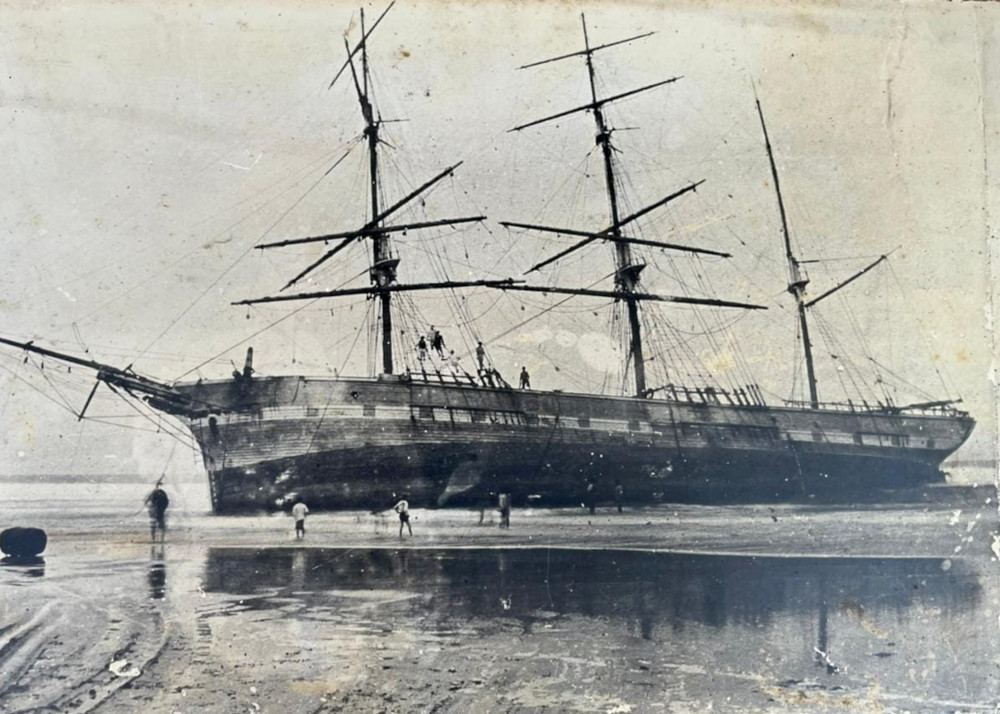
The wreck of the Volo is a significant maritime site located off the coast of Kenton-on-Sea, South Africa. This shipwreck not only tells a story of nautical misfortune but also serves as a reminder of the region’s rich maritime history.
In 2017 the wreck of the Volo was also exposed leading to the video below from Herald Live:
Volo was a 593-ton barque stranded in the Bushman River in South Africa.
Volo had been built at Arendal, Norway in the 1880s and was homeported there. She undertook her final voyage under Captain Olsen, sailing from Goteburg, Sweden, carrying a cargo of Baltic pine timber to Lourenço Marques, Portuguese East Africa. Volo was sailing by dead reckoning, and on 5 March 1896 Captain Olsen judged the ship to be 200 miles from the coast. The following day Volo struck rocks off the coast and was holed, but was carried over the reef and successfully beached between Kwaaihoek and the mouth of the Bushman River.
The crew climbed into the rigging, and after some hours all 12 were able to reach the shore using lines secured with the help of local people who came to offer assistance. Some of the remains of Volo and her cargo were used to build houses in the area, and other artefacts were salvaged and are still displayed nearby.
“Volo” – the barque from Arendal that ran aground in South Africa On 30 November 1895, the barque “Volo” left Gothenburg. The ship was loaded with planed boards and destined for Delagoa Bay in Mozambique. The crew numbered 12 men and the captain on board was Martin Karinius Olsen. This was the first time Olsen was skipper for “Volo” on a long trip. It was also to be the last.
The barque “Volo” was built by master shipbuilder Ole Martin Olsen at Indre Bratteklev shipyard on Tromøya outside Arendal in 1891. The ship measured 593 registered tons and was specially built for the transport of timber. “Volo” was operated by the shipping company Chr. Eyde & Hein and the ship’s first captain was Knud Knudsen. On 6 February 1892, the schooner left Arendal. It would be over three years before “Volo” returned to his hometown.
After loading timber in Fredriksstad, “Volo” set course for the southern tip of Africa. After 73 days at sea, the schooner arrived in Algoa Bay on 10 June 1892. From Africa, the trip continued across the Atlantic to Pensacola in the USA. In the USA, wooden beams were loaded before “Volo” again set course for southern Africa. From there, the journey continued across the Indian Ocean, around Australia and to the island states of Tonga and Samoa in the Pacific Ocean. Fully loaded with copra (dried coconut meat), “Volo” left Samoa on 26 January 1894.
127 days later the ship arrived at its destination Cádiz in Spain. From Europe, the trip went on to South America. Wheat was loaded here to return to Europe. Only in the late summer of 1895 did “Volo” return to his home town of Arendal.
On their journey, the crew on board had experienced both storm and calm, and exotic ports in various parts of the world. During the last voyage across the Atlantic, however, things turned very dramatic. In the early morning hours of Tuesday 26 March 1895, the crew on board “Volo” caught sight of a ship in distress. The ship was the Swedish barque “Ponemah”.
In the middle of the Atlantic Ocean, the Swedish sailing ship had sprung a leak. The mate and a sailor were already dead. The rest were rescued on board “Volo”. A year later, it was the crew of “Volo” who needed help.
On the last day of November in 1895, “Volo” left Gothenburg. The ship was again going on a long trip to southern Africa, but this time it was Martin Karinius Olsen who was the captain.
The first months of the voyage passed without drama, but on the morning of 6 March 1896, the fatal thing happened.
“Volo” approached the mouth of the Bushman’s River at the southern tip of Africa. There was thick fog and rough seas. Suddenly, surf was observed straight ahead.
Captain Olsen immediately gave the order to steer away, but it was too late. “Volo” ran aground hard. Parts of the keel floated up the sides of the ship, and the rough sea washed in over the deck.
The deckhouses were filled with water and the crew was in danger of being washed overboard. The fog made it impossible to see land, but after about 15 minutes it began to lift. Then the crew discovered that “Volo” was only two ship lengths from shore.
The sea continued to rage with the schooner from Arendal, but after about half an hour people appeared on the beach. On board “Volo”, several attempts were made to land a lifeline, but in vain.
From shore, however, an African farmer managed to swim out to the ship and retrieve a line. With the help of the line, the crew managed to pull themselves ashore. Captain Olsen was the last to leave the wrecked ship.
On land, the lost Norwegian crew were taken care of by the African farmers. One of the crew was injured and had to be sent to hospital, but otherwise the crew was safe. It was worse with “Volo”. The keel was broken and large parts of the hull were smashed to pieces. However, the cargo and certain parts of the ship could still have a value. After the sinking, an auction was therefore held where ship parts and cargo were sold to the highest bidder.
After the shipwreck in 1896 “Volo” was scrapped for valuables. The remains of “Volo” were left on the beach as a reminder of the dramatic sinking. After years of harsh weather conditions, more and more of the ship disappeared. In recent times, however, parts of “Volo” have reappeared in the sand.
As recently as 1999, the front tire of “Volo” was discovered on the beach, but rather than end up in a museum, the parts disappeared after a few years. However, traces of “Volo” can be found in some of the houses near the shipwreck site.


