1865: Dane SS, this steam-powered 530 ton British Royal Mail Ship wrecked during a south west wind on Thunderbolt reef just northeast of Cape Recife in Algoa Bay in the Eastern Cape. The captain tried running between Roman Rock and the shore, striking a previously unknown reef and wrecking. The RMS Dane was the pioneer Union Line mail ship to South Africa. No lives lost. Dane was built in 1855 by Langley, London and owned by the Union Company. At the time of the wrecking she was commanded by Captain Waldeck. She was under charter by the Admiralty to convey stores from Table Bay to Zanzibar. The stores were intended for naval forces who were suppressing the slave trade. She was stranded instide the wreck of the L’Imperatrice Eugenie (1867).
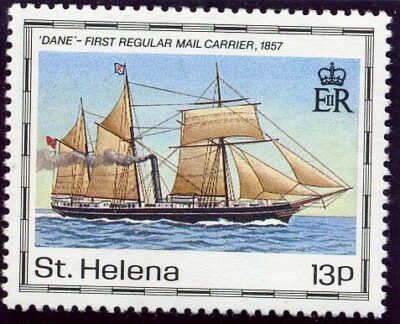
Dane was the first regular mail service ship to the Cape Colony.
Built on the yard of Charles Lungley & Co., Rotherhite, London for the Union Steam Colliers Co., London, the later Union Line.
Tonnage 550 gross, 421 net, dim. 59.44 x 7.65 x 5.08m.
Direct acting 2-cyl steam engine, manufactured by the shipbuilder, 60nhp., speed 8 knots. One screw.
She was built as a collier for the South Wales to Southampton coal trade and to supply bunker coal to the steamships liners calling at that port, but she was immediately chartered after delivery by the French Government for use during the Crimean War. She carried war materials from and to Turkey.
After the war there was not much need more to transport coal from South Wales to Southampton and in 1856 she was laid up at Southampton.
A decision was made by the company to open a new line to Brazil. 21 March 1857 she sailed from Liverpool in this service to Brazil.
On 5 December 1856 the company name was changed as the ships did carry coal anymore, to Union Steam Ship Company.
When used in the Brazil service she could accommodate a few cabin passengers. The line carried also the mail to and from Brazil.
The outlook for the service to Brazil did not look very well, and when the British Admiralty invited tenders for a mail service to the Cape Colony, the company admitted an application, which was accepted on 04 September 1857. The contract, valued at £33.000 per annum. The vessels in the contract had to make the passage from the U.K. to the Cape within 42 days.
On 15 September 1857 the DANE sailed from Southampton as first vessel in this service under command of Capt. Strutt with the mails to the Cape Colony. She arrived in Cape Town 29 October, a few days late according to the contract.
The mail contract service started so quick, that the people on the Cape not even knew that a mail ship was due.
The Cape Town Monitor of 31st October 1857 gave this report: The arrival of the Royal Mail Steamer DANE on Thursday has thrown new life and vigour into community. When our hopes were lowest the intelligence burst upon Cape Town that mail communication with England had been resumed. The old country has not yet begun to forget the interest of her dependencies. At a time when all attention might have been supposed to be absorbed in providing for the ominous struggles now proceeding in the Indian Empire (the Indian Mutiny), the British Government, instead of withdrawing Mail communication with the Cape, has only renewed it on the most satisfactory of terms.
The DANE sailed from Cape Town on 30 November and made the voyage via St Helena and Plymouth, with a full cargo on board and the largest mail delivery from the Cape so far, 10.867 letters and 3.671 newspapers. The return earning for the company on this voyage was £980.
After complaints from the people living in the Eastern Cape that it took very long, before the mail landed in Cape Town did reach them, the mail service was extended to Port Elizabeth in 1862. The Union Line got this coastal mail contract. In 1864 extended to Mauritius. The Mauritius service was short lived, the mail from the Cape was collected and in Mauritius put on board of a P&O liner, a quicker service, but it was more expensive and not reliable. When the coastal steamer did not arrive in time the P&O liner had sailed.
The DANE was used in this coastal mail service.
In 1865 She was chartered by the British Government for the Zanzibar expedition to suppress slave trading.
On a voyage from Table Bay to Zanzibar, under command of Capt. Waldeck she was wrecked on Thunderbolt Reef off Cape Receife on 01 December 1865 during a south-west wind. She took the inner passage between Thunderbolt Reef and the mainland and stranded inside the wreck of the L’IMPERATRICE EUGENIE. There was no loss of lives, but she was a total loss on 4 December.
1917: John H Kirby, this American transport barque was scuttled by the German raider, SMS Wolf, about 400km offshore from Algoa Bay in the Eastern Cape. After capturing the barque, the passengers and useful cargos were transferred, and then, the following day with 270 ford cars destined for Durban still on board, it was scuttled using explosives attached to the starboard side.
1965: Rocktail, this motor-powered fishing vessel wrecked at Kosi Bay in KwaZulu-Natal.
1967: Bonanza, this motor-powered fishing vessel ran aground and burned out at Port Alfred in the Eastern Cape.